Net Zero Buildings
Working with partners on the decarbonisation of buildings
Scottish Government is legally committed to meeting targets set out within the Climate Change (Emissions Reduction Targets) (Scotland) Act 2019, which includes reaching net zero by 2045.
With Scotland’s buildings accounting for approximately 20% of the country’s total greenhouse gas emissions, Scottish Government’s Heat in Buildings Strategy emphasised the urgent need to tackle the emissions associated with our buildings to ensure Scotland achieves its climate change targets.
The focus of our Net Zero Buildings team is to work with partners on the decarbonisation of the built environment as set out in the Heat In Buildings Strategy.
Working towards that goal, we seek to create an environment where Scotland can attract the scale of investment that is needed from the private sector into areas such as heat networks.
We also facilitate the development of innovative private sector-led financial solutions for our homes and buildings. In doing so, we are focussed on supporting a just transition, the creation of green jobs, improving the environment and increasing well-being. To deliver Scotland’s ambitious 2045 climate change target, the public sector must show leadership and demonstrate, through its own estate, what can be achieved.
We help drive the change that is needed by both supporting project development and also, drawing upon lessons from what has gone before to provide the right tools and guidance. To deliver this work, our team works closely with other workstreams within SFT, as well as other organisations as experience tells us we can achieve more by collaborating on the delivery of shared ambitions.
Our work is primarily focused on the following programmes:
To deliver Scotland’s ambitious climate legislation by 2045, the public sector must show leadership and demonstrate, through strategic management of its own estate, what can be achieved.
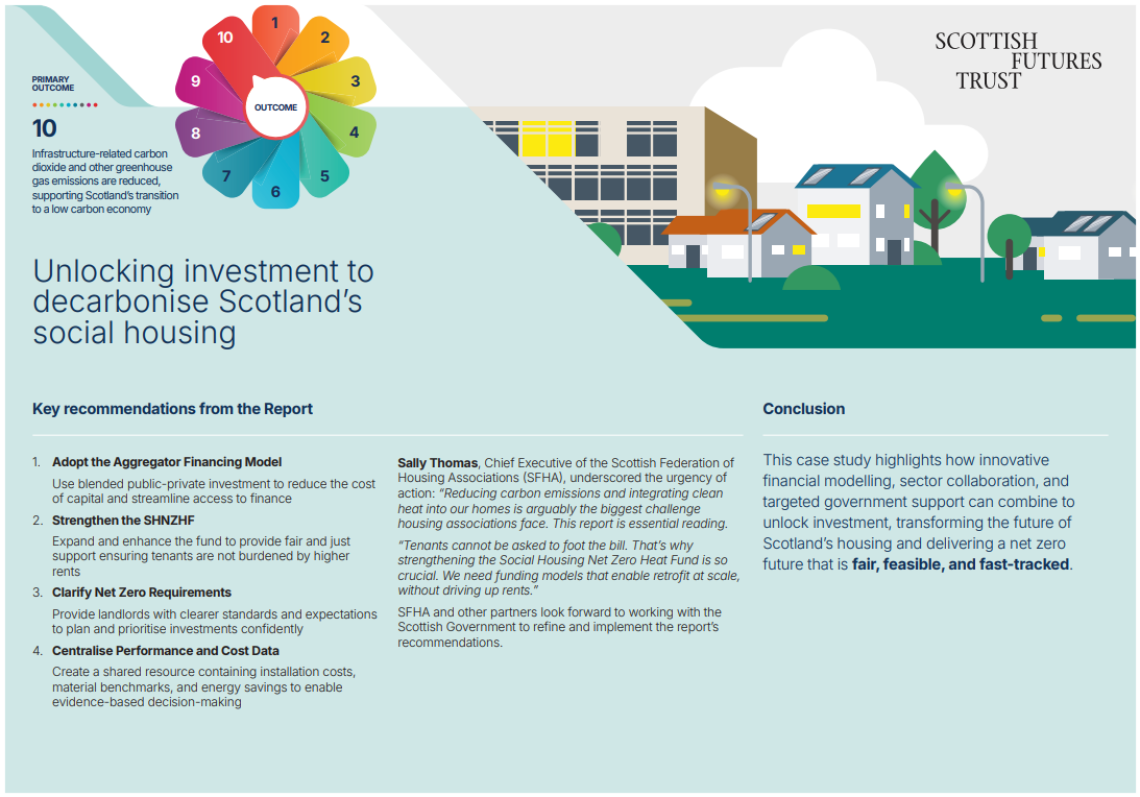
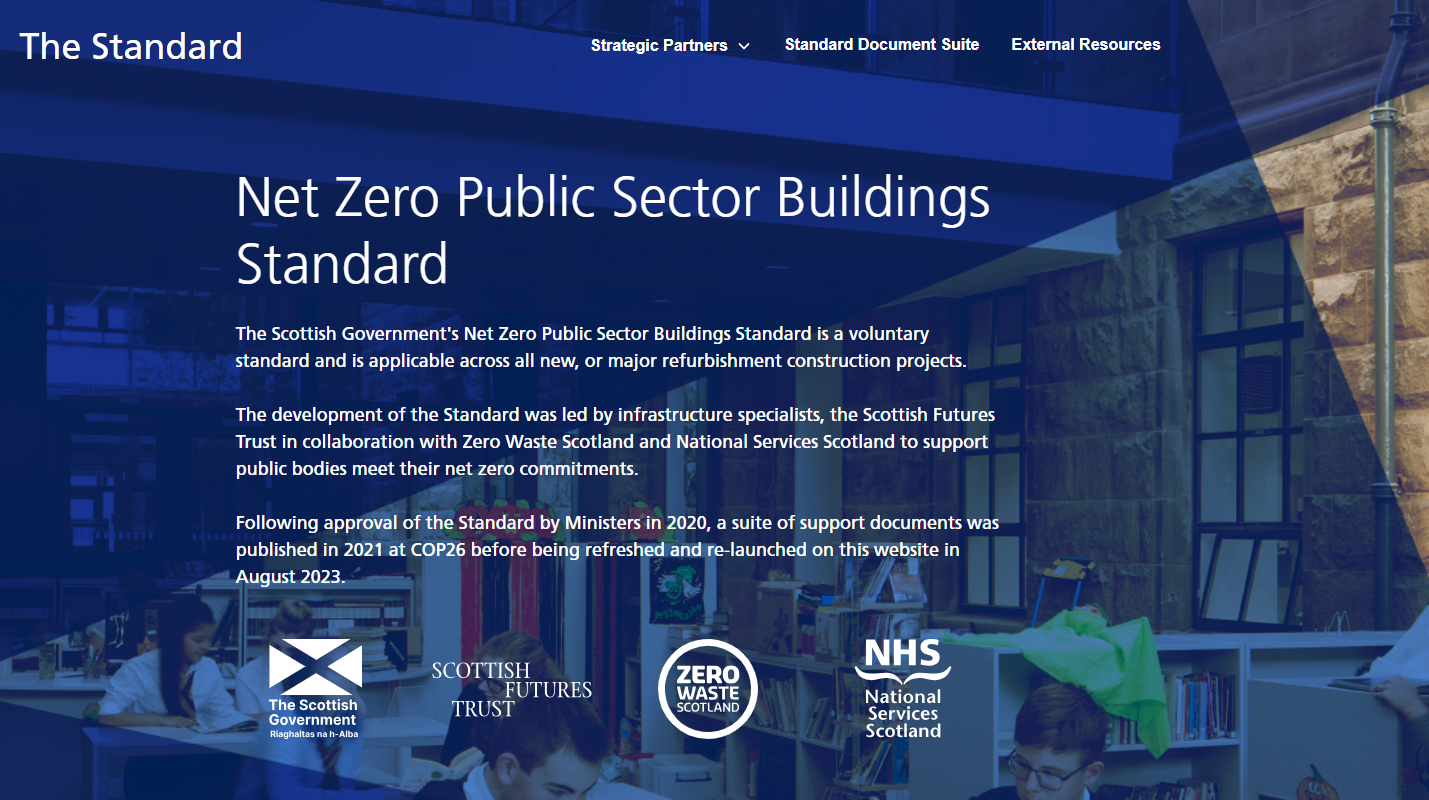
Our Net Zero Buildings team in partnership with Scottish Government, Zero Waste Scotland and National Services Scotland, has developed and expanded the Net Zero Public Sector Buildings Standard to support public bodies to decarbonise their built assets by their net-zero deadlines.
The Standard was first adopted by Scottish Ministers in 2020 covering new construction and major refurbishment projects and further developed in August 2023 to include existing buildings and construction intervention strategies aligned to objectives around place, carbon and the wider environment.
The re-launched Standard now has its own dedicated website where a comprehensive suite of supporting documents and third-party resources can be easily accessed.
A heat network is a system that supplies heat from a central or shared source to multiple homes and buildings through a network of pipes, avoiding the need for individual heating solutions in each building such as gas boilers.
Why heat networks?
To help achieve climate change and net-zero targets we need to reduce carbon emissions from heating buildings. Scotland’s Heat in Buildings Strategy identified Heat networks as one of a number of low/no regret technologies for reducing emissions from heating our homes and buildings.
In order to meet statutory targets we need to accelerate the pace and scale of heat network deployment. However, there are significant challenges to delivering heat networks Scotland, including, developing investable propositions, a lack of skills, knowledge and resource.
To help achieve Scotland’s net-zero targets, the Scottish Government has set ambitious targets for heat network deployment, supported by a range of policy initiatives, financial incentives and regulatory measures. These will help to build skills and capacity, facilitate the identification and development of projects, and the regulation of heat network operators.
The Scottish Government has put in place a range of support for heat networks through funding programmes for development and capital costs, as well as expert guidance and advice. This includes the Heat Network Support Unit, which includes representatives from our Net Zero Buildings team, and aims to support the growth of large-scale heat network projects in Scotland.
Our role in supporting heat network deployment
The Heat Network Support Unit (HNSU), which is sponsored and managed by the Scottish Government, with partners Scottish Futures Trust (SFT) and Zero Waste Scotland (ZWS), provides a range of support to help create the conditions for accelerated heat network development in Scotland.
The HNSU aims to help address the key challenges faced in the pre-capital stages of project development and building capacity across the public sector to deliver successful heat network projects through grant funding and expert advice. For more information, including how to apply for support, visit: Heat Network Support Unit.
Heat Network Supporting Material
As part of our role in supporting the delivery of heat networks we have developed a range of materials including reports, guidance and templates. For more details of the support available, please contact a member of our Net Zero Buildings team, or the HNSU, link above.
Two examples of our work are the Delivery Models report and Strategic Heat Network Development route-map which are set out below.
Heat network delivery models
In order to support the delivery of heat networks, during 2023 Scottish Government asked our Net Zero Buildings team to review various delivery models and assess their potential for increasing the pace and scale of heat networks across the country.
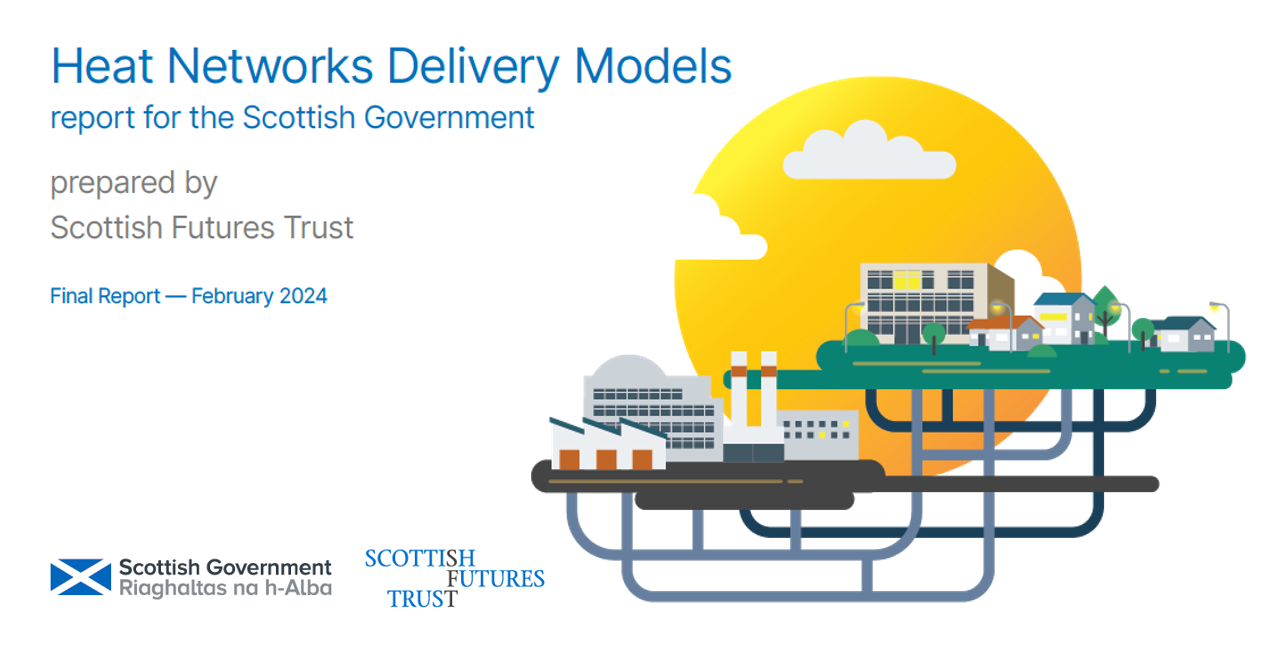
That work is complete and our report makes a number of recommendations, highlighting that whilst some existing models can be improved, some potential new models could help deliver more networks quicker.
To help support strategic heat network delivery – which includes both funding and advisory functions – help local authorities build on Local Heat and Energy Efficiency Strategies (LHEES) to develop a strategic and commercial approach to deploying large scale heat networks in their respective areas.
Strategic Heat Network Development route-map
Together with Zero Waste Scotland we have developed a draft Strategic Heat Network Development route-map to help local authorities plan and navigate through the complexities of strategic heat network infrastructure design and delivery.
If you want to hear more or to discuss support available for support, please contact the HNSU at HeatNetworkSupport@gov.scot.
Together with Zero Waste Scotland we have developed the draft Strategic Heat Network Development route-map.
As noted on the route map, this has been drafted to help local authorities plan and navigate through the complexities of strategic heat network infrastructure design and delivery.
The route-map, which does not constitute formal guidance, is part of supporting material being developed for a ‘pilot’ of Strategic Heat Network Support for local authorities, which is currently being delivered through the Heat Network Support Unit (HNSU).
As a draft and work in progress document, the outline process set out in the route-map is envisaged to be revised over time as learnings from different approaches emerge.
If you have any queries or feedback on the route-map, please contact the HNSU at HeatNetworkSupport@gov.scot.
The Heat in Buildings Strategy published in October 2021 includes a commitment to establish a Green Heat Finance Taskforce. Our team helped set up the taskforce and are co-secretariat alongside Scottish Government.
The purpose of the Taskforce is to develop a portfolio of innovative financial solutions for building owners in Scotland to ensure that by 2045, our homes and buildings no longer contribute to climate change, as part of the wider just transition to net zero.
The remit of the Taskforce is to:
- build on existing evidence to set out the alternative sources of funding and financing for heat decarbonisation, including existing technologies and new technologies which may develop, by September 2023 for both the medium and longer-term requirements
- explore and potentially pilot new and value-for-money innovative financing mechanisms for individual and community-level investment
- act as a catalyst for long-term relationships and partnering across the public sector, the heat sector industry, wider supply chain, building owners and investor/financial institutions
- support the alignment of the requirements for heat decarbonisation with the needs and investment activity across the wider energy system, considering returns and wider socio-economic benefits
For more information visit Heat in Buildings: Green Heat Finance Taskforce.
Since the launch of our Street Lighting Toolkit and procurement frameworks in 2014 we have provided summary business cases to all 32 local authorities and further support where needed, facilitating the replacement of over 75% of street lights with 680,000 energy-efficient LED equivalents.

Investment to date is over £220m, including £20m during the Covid lockdown period and has already saved local authorities £70m and will provide further estimated savings of £800m and 1.7m tonnes of CO2 over the lifetime of the replacement lanterns.
The street lighting toolkit has received several industry awards and has been adopted by UK Government for use in England and Wales. Indeed, over 200 organisations globally have downloaded this award-winning tool.
Our team

Stephen Vere
Senior Associate Director
Stephen is a Chartered Accountant, with a project finance background. Stephen leads the Net Zero Buildings team whose main priorities are the decarbonisation of heat, energy efficiency, delivering net zero infrastructure.
Contact Stephen
Ingrid Berkeley
Associate Director
Ingrid is a Chartered Engineer and Fellow of CIBSE (Chartered Institute of Building Services Engineers). She is a past Chair of CIBSE Scotland and has 15 years experience as a sustainability consultant; specialising in sustainability certification and building performance engineering. She has previously worked on projects applying the Scottish Net Zero Public Sector Buildings Standard.
She also sits on the Heriot-Watt University Industrial Advisory panel for the architectural engineering programmes and is an active STEM ambassador.
Contact Ingrid
Ryan Cossar
Associate Director
Ryan is a qualified Architect with over 20 years’ experience in the construction industry. He brings significant expertise having supported our work on the Edinburgh Home Demonstrator programme and Modern Methods of Construction to deliver higher performing buildings towards net zero, since joining SFT in 2021.
He joined the Net Zero Buildings team in 2025, working on the retrofit of public sector buildings.
Contact Ryan
Sheelagh MacGregor
Associate Director
Sheelagh is a lawyer in the Net Zero Buildings team, currently working on the development and delivery of heat networks. Sheelagh joined SFT in 2022 after 10 years in private practice, where she specialised in public law and the consenting of major infrastructure projects across various sectors, and undertook secondments to both private and public sector organisations.
Contact Sheelagh
Mary Frances O'Neill
Associate Director
Mary Frances is a lawyer in the Net Zero Buildings team, currently working on the development and delivery of heat networks. Mary Frances joined SFT in 2025 and has worked as a solicitor across both the public and private sectors since qualifying in 2007. She has extensive experience in major infrastructure projects, litigation and dispute resolution, and project management. She holds a Certificate in Project Management for Lawyers and brings valuable public law experience, having worked for three large Scottish public sector organisations as an inhouse solicitor.
Contact Mary Frances
Toby Tucker
Associate Director
Toby is a qualified Chartered Accountant and finance specialist with over 20 years' experience in corporate and project finance, as well as Banking. Toby leads SFT's work on Scottish Government’s Energy Efficient Scotland programme.
He led the development and delivery of SFT’s successful Streetlighting toolkit. He is a Director of Energy for Edinburgh service company.
Contact Toby
Kevin Waters
Associate Director
Kevin joined the Net Zero Buildings team in 2023, working on the development and delivery of heat networks. Kevin joined with over 20 years of project and programme management experience across multiple sectors, including delivering major infrastructure and renewable energy projects in the public sector and latterly in the private sector leading the remediation and development of a marine and renewable technology park.
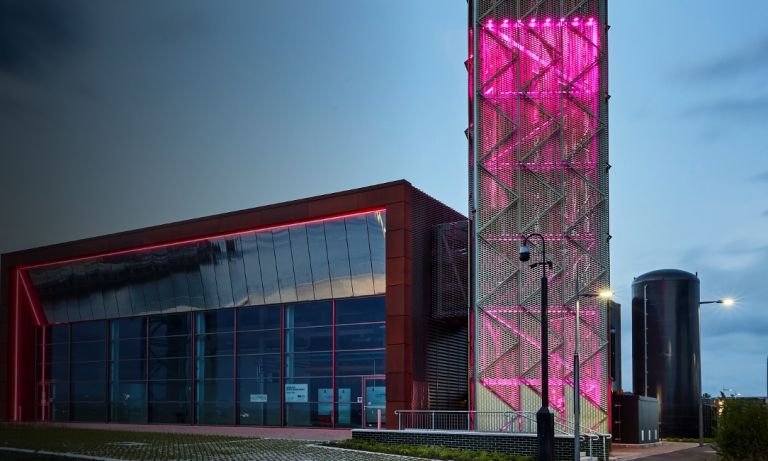
Kevin also played a pivotal role in leading the development of Scotland’s first 5th generation renewable energy heat network at the Advanced Manufacturing Innovation District Scotland.
Contact Kevin